 Visit Lisbon Guide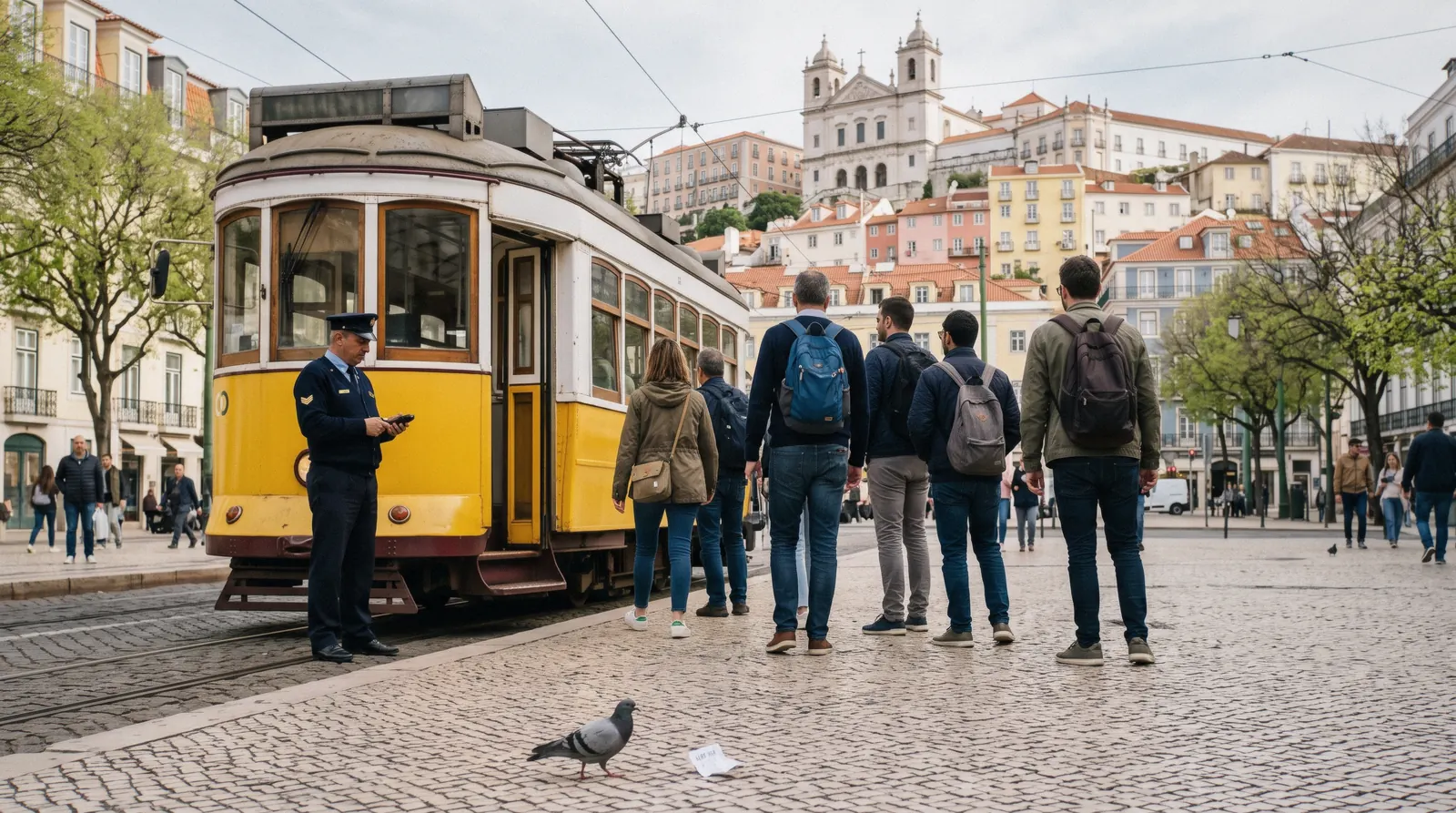
Lisbon Safety
Most Lisbon safety advice can be replaced by one sentence: this is a safe city to walk around, including at night, including alone. The British Foreign Office's Portugal advice, read on 29 August 2026, says the whole of it — be alert to the risk of street crime, take care on public transport and at crowded bus and tram stops, because thieves use distraction techniques and often work in teams. The rest of this page is the specific version of that sentence for Lisbon: which tram, which square, which approach on the pavement, plus the paperwork side — the number to dial, the station that speaks English, the law that decides whether the bread on the table is free. It belongs to the plan hub of the Lisbon city guide, next to the transport strikes page and what Lisbon costs, which cover the two other things that go wrong.
Quick answer Safe city, four specific approaches, one number, one address
Lisbon is safe. What it has is pickpockets on tram 28 and at its stops, a class of men on Rua Augusta selling fake hashish, a couvert on the restaurant table that is only a scam if you do not know the law, and steep limestone pavements that are lethal in the rain. There are no districts to avoid in daylight; the emergency number is 112 from any phone; the tourist police sit in the Palácio Foz at the foot of Avenida da Liberdade.
Key takeaways
- Ride tram 28 with the bag in front and nothing in a back pocket, or ride it at 07:00 — or take the tram 28 ride and walking tour at €20 (about $23), which puts a guide between you and the crowd.
- The bread and olives are the couvert: under Decree-Law 10/2015 nothing not ordered or touched can be charged — where to eat has the bill line by line.
- Since 14 February 2026 bars cannot sell a drink to take onto the street after 23:00 Sunday–Thursday or midnight Friday–Saturday; the drink you do have, keep in sight — the nightlife page has the night version of this page.
- First morning and unsure of the hills? The history, stories and lifestyle walking tour, €25 (about $29), covers the Baixa, Chiado and Alfama with someone who knows which steps are wet.
Is Lisbon Safe? The Honest Version
Yes, and it is worth being precise about why the question keeps being asked. The FCDO's safety-and-security page for Portugal — the wording read on 29 August 2026 — tells travellers to be alert to the risk of street crime, to take care on public transport and at crowded bus and tram stops, and that thieves use distraction techniques and often work in teams. It adds a warning about drink spiking with GHB and similar drugs, a warning about rip tides on the beaches, and the line that illegal drugs, including cannabis, carry severe penalties. It does not name Lisbon, tram 28 or any district, because it does not need to: that is the whole risk profile, and it describes a city where the crime that reaches visitors is theft by stealth in crowds.
What Lisbon does not have is the thing people are actually afraid of. Violent street crime against visitors is not the pattern; the old town is small, overlooked from every window and busy until late; a woman walking alone from a fado house in Alfama to a hotel in the Baixa at 23:00 is doing what thousands of residents do. The hills are the real hazard — the calçada portuguesa, the small limestone cubes on every pavement, polishes to glass under a million feet and is as slippery as ice when it rains, which on the IPMA normals is ten days a month from October to January. Shoes with tread are a safety item here; smooth soles are the cause of more visitor injuries than any thief.
So the honest advice is not to be nervous. Walk at night. Eat late. Take the last metro at 01:00 or the night bus after it. Just carry your bag the way a Lisboeta carries theirs — in front, closed, not on the back of a café chair on Rua Augusta — and treat any stranger who initiates physical contact with your hands as the start of a transaction rather than a friendship.
Not ideal for
- If your own comfort depends on a district with no visible street disorder at all, the Intendente and Martim Moniz end of Avenida Almirante Reis after dark is the stretch you may want to walk around rather than through — a matter of atmosphere, not of recorded danger, and our reading rather than a police figure.
The Approaches You Will Actually See
Four of them, in the order a first-timer meets them. None is dangerous; each costs money or a morning if you do not recognise it.
The 'hash, coke' whisper on Rua Augusta
The most visible thing in the Baixa and the most harmless. Men stand along Rua Augusta, in Rossio and on the Bairro Alto corners and murmur a menu to anyone who looks foreign. What they sell is bay leaves pressed into a block and crushed paracetamol — a fraud that Portuguese law barely bothers with, which is why they are still there.
Do not answer, do not stop, do not take the offered hand. They do not follow and they do not escalate; the only person who loses is the one who pays €20 for laurel.
The couvert that is not explained
Bread, butter, olives, cheese and sometimes a plate of prawns or ham arrive before you have ordered. This is the couvert and it is legal, optional and priced: article 135(3) of Decree-Law 10/2015 says no dish, product or drink, the couvert included, can be charged if it was not requested or was left unused, and the price list must show it. The scam version is the unasked plate of shellfish at a marisqueira price, charged because you touched it.
Ask 'quanto custa?' before anyone reaches, and send back untouched what you do not want. The where-to-eat page has the bill line by line.
The tram-28 team
Not an approach — you will not see them — but the one theft that actually happens. See pickpockets below for where and how; the short version is that a wallet in a back pocket on a packed tram between Graça and Estrela is a wallet you have donated.
The 'closed today' helper and the petition
Older tricks, rarer in Lisbon than in Rome, but present around Belém and the Sé. A friendly stranger tells you the monastery is closed and offers to walk you to a 'better' one — it is a shop or a restaurant paying commission. A clipboard petition for a deaf charity is a distraction while a second person works your bag.
The monastery's real hours are on the Jerónimos page; the petition is declined by walking on.
Pickpockets: Where, When and How They Work
The map is short. The tram 28 stop at Martim Moniz, where the queue of visitors waits with phones out and bags open; the tram itself, especially on the packed stretch through Graça, Alfama and the Sé, where a full car and a sharp bend do the thief's work; the tram 15E to Belém for the same reason; the Baixa-Chiado and Cais do Sodré metro platforms at 00:45 when the last trains are filling with people who have been drinking; Santa Apolónia and Oriente stations when a long-distance train arrives; and the Santo António night of 12–13 June, when Alfama holds more people than at any other moment of the year. Outside those places, the pickpocket density of Lisbon is low.
The method is the one the FCDO describes: distraction, in teams. Someone blocks the tram door as you board, someone else is behind you; someone asks a question with a map, someone else has your bag open; a group of teenagers crowds the doorway at the stop and disperses at the next. The countermeasures are dull and they work. Nothing in a back pocket. Bag in front, zipped, hand on the zip in the crowd. Phone in a front pocket, not held out at the tram window. Passport in the hotel safe, a photograph of it on your phone. On the tram, stand at the back rather than the doorway. Or ride tram 28 at 07:00 when it is a commuter tram again, which the tram 28 page explains, or take the guided ride and walk where the group and the guide are the crowd.
If it happens: the card is cancelled by phone within the minute, the police report is filed at the tourist police station in the Palácio Foz or online, and the report is what your insurer needs. A stolen phone with a transit app on it is the practical problem — the navegante card in your other pocket still works, which is one argument for the €0.50 card over the phone.
The Night, the Drink and the 2026 Street Rule
The night is where the two FCDO cautions that are not about theft apply. The first is the drink: be alert to the possible use of date-rape and other drugs including GHB and liquid ecstasy, buy your own drinks and always keep them in sight. The Bairro Alto bars are the size of living rooms and the crowd stands in the street, so the glass leaves your hand more easily than in a seated bar; keep it. The second is drugs themselves — severe penalties, long sentences for smuggling — which is the legal reason, beyond the fraud, not to engage the Rua Augusta sellers.
The rule that changed the street this year: since 14 February 2026 the Câmara Municipal de Lisboa prohibits, across the whole city, the sale of alcoholic drinks for consumption outside the establishment from 23:00 to 08:00 Sunday to Thursday and from midnight to 08:00 on Fridays, Saturdays and the eves of public holidays. Drinking inside and at the seated places of licensed terraces is unaffected. In practice the Polícia Municipal is visible on the Bairro Alto and Cais do Sodré corners after midnight, and a plastic cup carried out of a bar after the hour is what they are looking at. The nightlife page has the hills, the hours and the night buses; the metro closes at 01:00 and the Carris night network runs 23:30–05:35.
Walking home is the safe option it looks like. The Baixa, Chiado and the riverfront are lit and busy to 03:00 at weekends; the Alfama and Mouraria lanes are dark and steep and empty rather than dangerous, and the risk there is the wet calçada, not a person.
Taxis, Cash Machines and the Small Overcharges
The things that cost a visitor money in Lisbon are not crimes, and most of them have a rule behind them. Sources: the operators' 2026 tariffs where a figure is printed, and the FCDO where it is a caution; where we could not read an official page, the cell says so.
Taxis are metered, cream-coloured and honest by European standards; the official fare table was on no page we could read, so no figure is printed here, and the ranks at the airport, Rossio, Cais do Sodré and Praça dos Restauradores are where to find one. The app cars work in Lisbon and price the ride before you get in. From the airport the metro is the cheap certainty: the Red line from the Aeroporto terminus at the standard fare with no airport surcharge in the 2026 tariff, 06:30–01:00, or the private transfer at €24 (about $28) for a fixed price at any hour.
| The situation | The rule or the figure | Source |
|---|---|---|
| Airport to the centre | Metro Red line at the standard fare: €1.90 ticket, €1.72 zapping, €1.92 contactless bank card; no surcharge. Carris bus 744 and 783 serve the airport at €2.30 on board | Metro and Carris 2026 tariffs |
| A taxi fare | Not stated — official table not on a readable page. Metered; agree nothing in advance except the destination | — |
| Cash machine: 'pay in your currency?' | Choose euros. The terminal's own conversion is worse than your card's; this is dynamic currency conversion, legal and expensive | General card-scheme rule; no Lisbon figure |
| Cash machine: fees | Bank-branded Multibanco machines charge no fee of their own on a foreign card in our experience; the standalone machines in tourist streets print a fee on screen — read it and cancel | Our observation; no official table |
| The tram fare on board | €3.30 on board a tram, €2.30 on a bus; €1.72 zapping on a €0.50 navegante card. An inspector fines a passenger without a validated ticket; the amount is not on a page we could read | Carris 2026 tariff |
| Tourist tax at the hotel | €4 (about $5) per person per night, up to 7 nights, from age 13, paid to the hotel — a real charge, not a scam | Câmara Municipal de Lisboa service page (snippet; page 403) |
| Restaurant 'service' | Service is in the menu price; a service line must be on the price list to be charged; the couvert is optional under Decree-Law 10/2015 | Decree-Law 10/2015 art. 135(3) |
The one hire-car warning that matters in Portugal is the toll: many motorways, including the ones to Sintra's coast and the south, have electronic-only tolls that are read by a transponder, not a booth, and a hire car without the device accumulates fines the company will bill later with a fee. Ask for the transponder at the desk. Inside the city there is nothing to hire a car for, and the lorries of the transport page are the reason.
Emergency Numbers, and Where to Actually Go
The numbers and addresses to have on a phone before you need them. The 112 line is the FCDO's own instruction; the police addresses are from psp.pt, the regional tourism entity and the national tourism site, all read on 29 August 2026 — with one conflict between them printed as found.
One number covers everything: in an emergency, call 112. It is free from any phone including one with no SIM, and it routes to police, fire and ambulance. For the non-emergency things a visitor needs — a theft report, a lost passport, a document in English — the PSP runs a tourist police station.
| What you need | Where to go or what to dial | Detail |
|---|---|---|
| Any emergency | 112 | Free from any phone. Police, fire, ambulance |
| The tourist police (Esquadra de Turismo) | Palácio Foz, Praça dos Restauradores, 1250-187 Lisboa | +351 213 421 623, [email protected]. Address from psp.pt, phone from ertlisboa.pt; psp.pt prints no opening hours, so none are printed here. The national tourism site visitportugal.com lists a tourist-support station at the Jardim do Tabaco cruise terminal instead, +351 219 021 950 — two addresses, both official, so try Restauradores first and the terminal if a ship is in |
| Report a theft | The tourist police, or any PSP station | The report is what the insurer needs; a stolen passport also needs your consulate for an emergency travel document |
| Immigration and visas (AIMA, formerly SEF) | Rua Álvaro Coutinho 14, 1150-025 Lisboa | Contact centre +351 217 115 000, [email protected], working days 08:00–17:00 — for overstays and residence questions, not for a lost passport |
| The tourist office | Ask Me Lisboa, Praça do Comércio, 1100-148 Lisboa | +351 210 312 810, daily 10:00–19:00; also at the airport, Rossio and Cais do Sodré. Not a police station, but English-speaking and open every day |
| A pharmacy at night | Look for the green cross and the 'farmácia de serviço' notice | Every pharmacy posts the nearest one on duty that night; a citywide list was not on a page we could read |
| Transport strike or cancellation | The operators' own notices | Notice must be given at least five working days ahead under the Código do Trabalho — the strikes page explains where it is posted |
Heat, Steps, Water and the Rest of the Small Stuff
The things that actually send visitors to a pharmacy in Lisbon are not thieves. Heat first: IPMA counts 8.5 days above 30°C in an average July and 10.2 in August, the castle hill and the Belém waterfront have no shade, and the queue for the Jerónimos cloister stands in the sun. Carry water, do the hills before 11:00, and read the best-time page before promising anyone the castle at 14:00 in August. The tap water is safe to drink and asking for it at a restaurant is legal.
The steps second. Alfama, Mouraria, Graça and the Bairro Alto are stairs as much as streets, the funiculars that used to save the climb — Glória, Bica, Lavra — and the Santa Justa lift have been closed since the 3 September 2025 derailment with no reopening date on carris.pt, and the replacement buses do part of the job. Anyone with a knee, a pushchair or a wheelchair should read the accessibility page before choosing a hotel on a hill.
The sea third: the FCDO's line on rip tides — do not swim against one, swim parallel to the shore until the current lets go — belongs to the beaches page, but it is the one piece of Portugal safety advice that is about drowning rather than theft, so it is repeated here.
And the earthquake, because people ask: Lisbon was destroyed in 1755 and rebuilt on the Pombaline grid you walk in the Baixa, and the region is seismically active; the practical advice is the same as anywhere — know where the door is — and the risk on a week's holiday is not one to plan around.
Not ideal for
- If you are travelling with a wheelchair or a mobility limit, the honest version of this page is that the old town is not built for you and the closed funiculars have made it worse since September 2025 — the flat routes and the accessible monuments are on the accessibility page, and a hotel in the Baixa or Parque das Nações rather than Alfama is the safety decision that matters most.
The Two Situations Worth Handing to Somebody Else
The tram at rush hour and the first morning on the hills — the two moments when a guide is a safety measure as much as a luxury — plus the fixed-price transfer for a late arrival. Prices, ratings and review counts are the platform's own figures, checked on 29 August 2026.
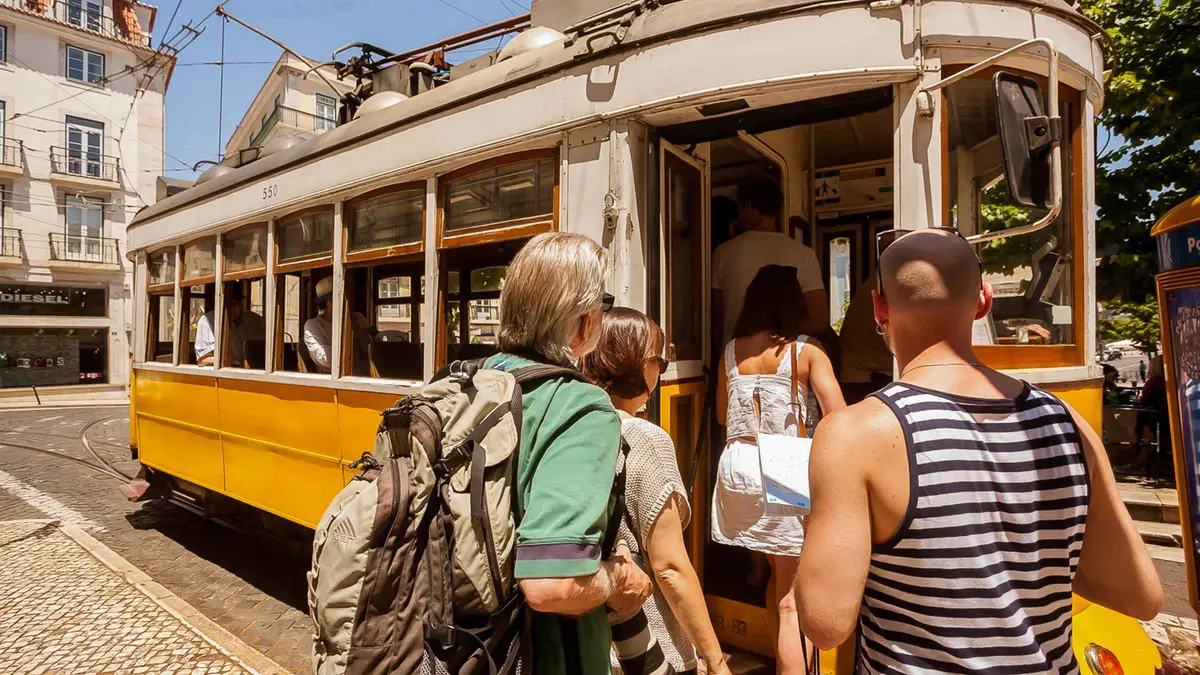 from €20
Lisbon Tram No. 28 Ride & Walking Tour
€20 — listed at $23.17; the platform charges in your own currency
Listing details checked 2026-08-29
Three-hour combination of a ride on Tram 28 up the hill and a guided walk through Alfama and its viewpoints. Solves the packed-tram problem by riding it with…
- Ride the historic Tram No. 28 across Lisbon Old Town
- Enjoy breathtaking and panoramic city views
- Walk through the picturesque neighborhood of Alfama
- Learn about Fado
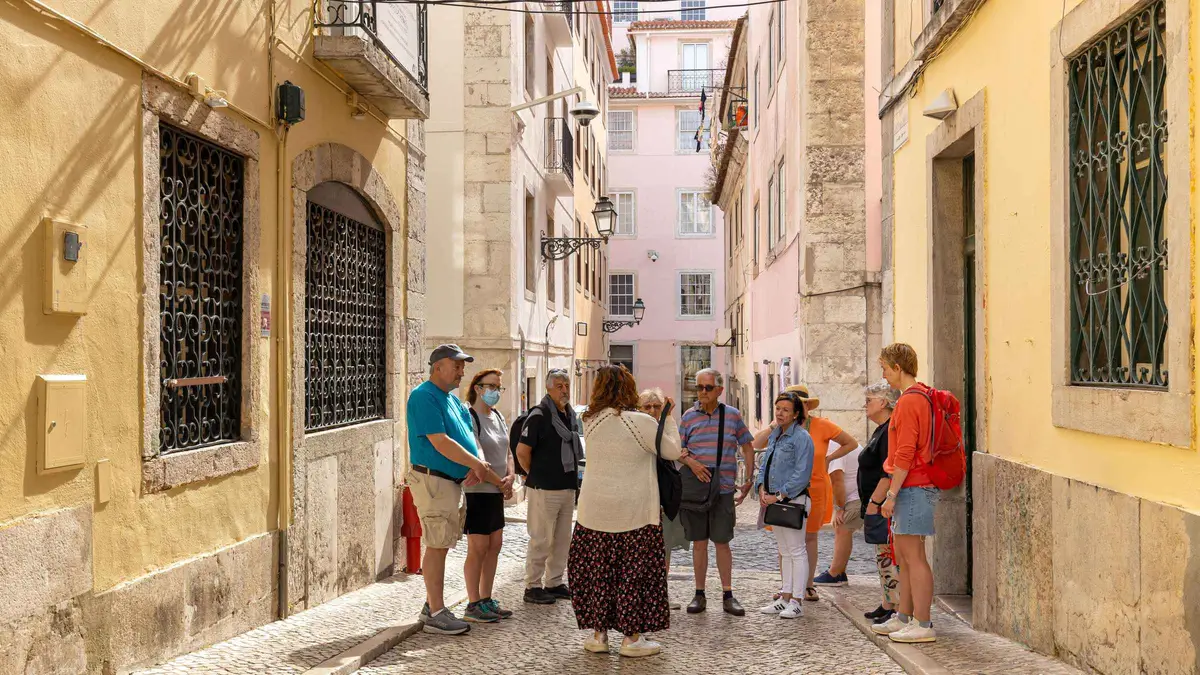 from €25
Lisbon: History, Stories and Lifestyle Walking Tour
€25 — listed at $28.96; the platform charges in your own currency
Listing details checked 2026-08-29
Three-hour guided walk through Chiado and Bairro Alto up to the Miradouro de São Pedro de Alcântara, built around the city's history and everyday life. Hills and cobbles…
- Visit the Bairro Alto, dating from the 16th century
- Take in the views from Miradouro São Pedro de Alcântara
- Take a ride on an iconic Lisbon tram
- Explore the Alfama district, the city’s oldest and most picturesque neighborhood
 from €24
Lisbon Airport: Private Transfer To/From Lisbon
€24 — listed at $27.80; the platform charges in your own currency
Listing details checked 2026-08-29
Private door-to-door transfer between Lisbon Airport and your accommodation, about 30 minutes. The Metro does the same run for a few euros — this is for luggage, late…
- Have a hassle-free private transfer between the airport and your hotel
- Enjoy meet-and-greet service in the airport's arrivals hall
- Sit back and relax in the comfort of an air-conditioned vehicle
Where to Go Next
The tram itself
Why 28 is a commuter tram the guidebooks colonised, and the 07:00 trick: tram 28.
Martim Moniz to Campo de OuriqueThe other thing that goes wrong
How a Portuguese transport strike is announced, the five-day notice and the minimum services: Lisbon strikes.
5 working days' noticeThe bill, line by line
The couvert law, the service line and the standing coffee: where to eat in Lisbon. Or go back to the Lisbon city guide.
Decree-Law 10/2015Lisbon Safety: Questions
Is Lisbon safe to visit right now?
Yes. The FCDO's Portugal advice, read on 29 August 2026, describes the risk as street crime — pickpockets using distraction in crowds and on public transport — and nothing more serious. The specific places are the tram 28 queue and the tram itself, covered in pickpockets; the rest of the city is walked at every hour.
Are there areas to avoid in Lisbon?
None in daylight. After dark the Intendente and Martim Moniz stretch of Avenida Almirante Reis has visible street disorder that some visitors prefer to walk around — our reading of the atmosphere, not a police figure. Alfama and Mouraria at night are dark and steep rather than dangerous; the hazard is the wet pavement. See the honest version.
Is it safe to walk around after dark?
Yes, including alone. The Baixa, Chiado and the riverfront are lit and busy to 03:00 at weekends; the metro runs to 01:00 and the night buses 23:30–05:35. Keep your drink in sight in the bars — the FCDO's drink-spiking caution — and the bag in front on the last metro. The night section and the nightlife page have the detail.
What is the emergency number in Lisbon?
112, free from any phone including one with no SIM, for police, fire and ambulance. The tourist police station is in the Palácio Foz on Praça dos Restauradores, +351 213 421 623; its hours are not printed on psp.pt. Emergency numbers has the full table, including the second address the national tourism site lists at the cruise terminal.
Which tram do the pickpockets work?
Yes — it is the one place in Lisbon where theft is routine, because the tram is packed, the stretch through Graça and Alfama is full of bends, and the queue at Martim Moniz stands with bags open. Ride it at 07:00 when it is a commuter tram, keep everything in front pockets, or take the guided tram ride and walk. Pickpockets has the method and the countermeasures.
Is Portugal friendly to US citizens?
Yes, in every practical sense: English is spoken in every tourist-facing job, US cards work everywhere a card is taken, and the city's tourist office on Praça do Comércio is open daily 10:00–19:00 in English. Entry runs on the Schengen rules for short stays, which change — the EU's own site and your embassy are the sources, not this page. The tourist tax of €4 (about $5) a night applies to everyone from age 13.
Lisbon Scams on Video
Three films that name the scams and tourist traps listed on this page, from the Baixa 'sunglasses' sellers to the tuk-tuk pricing, useful to watch before the first walk down Rua Augusta.
LISBON SCAMS EXPOSED!🇵🇹 Must Watch Before Visiting
The common street scams named, the same list this page describes.
Video: Dave in Portugal14 Tourist Traps in Lisbon, Portugal to Avoid!
Fourteen tourist traps, including the restaurant cover-charge point covered above.
Video: Nations Without Borders10 SCAMS & RIP-OFFS TO AVOID IN LISBON!
Ten rip-offs to avoid, overlapping the taxi and tuk-tuk notes on this page.
Video: STAY CLASSY VLOGVideos load from YouTube only when you press play. Prices and closures mentioned on camera may predate the 2026 changes printed on this page.
Page last reviewed 2026-08-29. Prices, hours and terms are set by the venue or operator and confirmed at checkout.
We may earn a commission if you book through one of our links, at no extra cost to you. Full affiliate disclosure